How to write content AI can actually extract
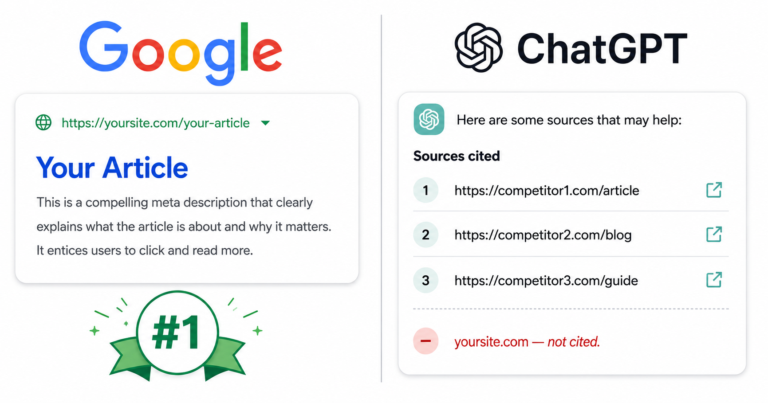
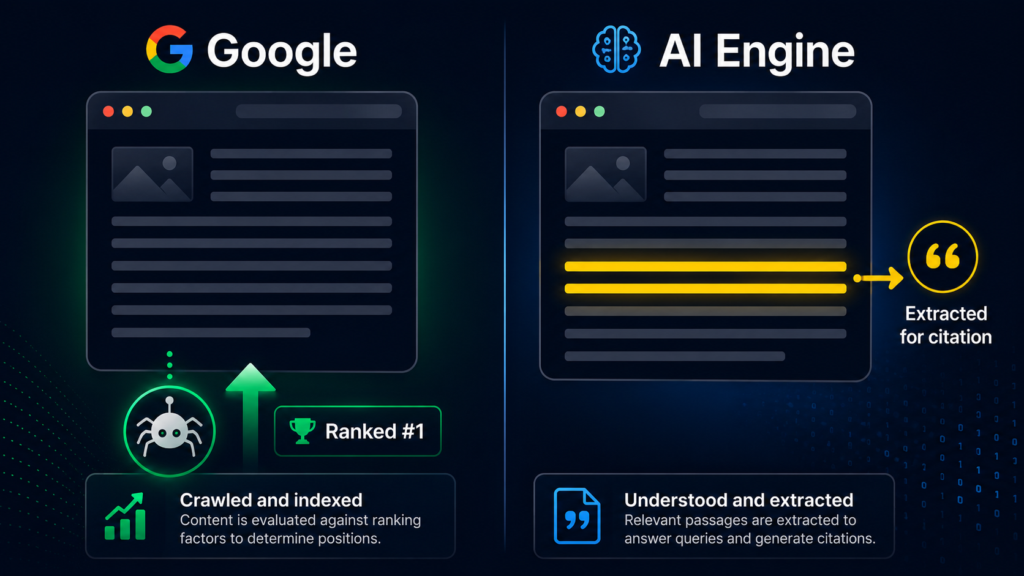
AI search engines don’t read your content the way a human visitor does. They use a process called Retrieval Augmented Generation — RAG — to find and pull specific passages from pages they’ve indexed, then use those passages to construct generated answers. The key word is *passages*. Not pages. Chunks of 50 to 200 words that can stand alone as a complete answer to a specific question.
This guide is for WordPress content publishers who rank on Google but aren’t appearing in AI-generated answers. If your key claim is buried in paragraph six inside a 700-word section, the retrieval system may never find it. If your answer to “what is X?” requires reading three paragraphs of context before it makes sense, it won’t get extracted. This is the most common reason well-ranked content gets zero AI citations, and it’s entirely fixable without rewriting a word of substance. The other four reasons your content may be getting passed over are covered separately. This post is about structure.
Why does content structure affect AI citations?
AI engines cite passages, not pages. When ChatGPT or Perplexity constructs an answer, it retrieves fragments of content that can stand alone — complete thoughts with a subject, a claim, and enough context to be understood without reading the surrounding text. Your content may contain exactly the right information, but if it isn’t formatted into retrievable chunks, the retrieval system moves on to a source that is.
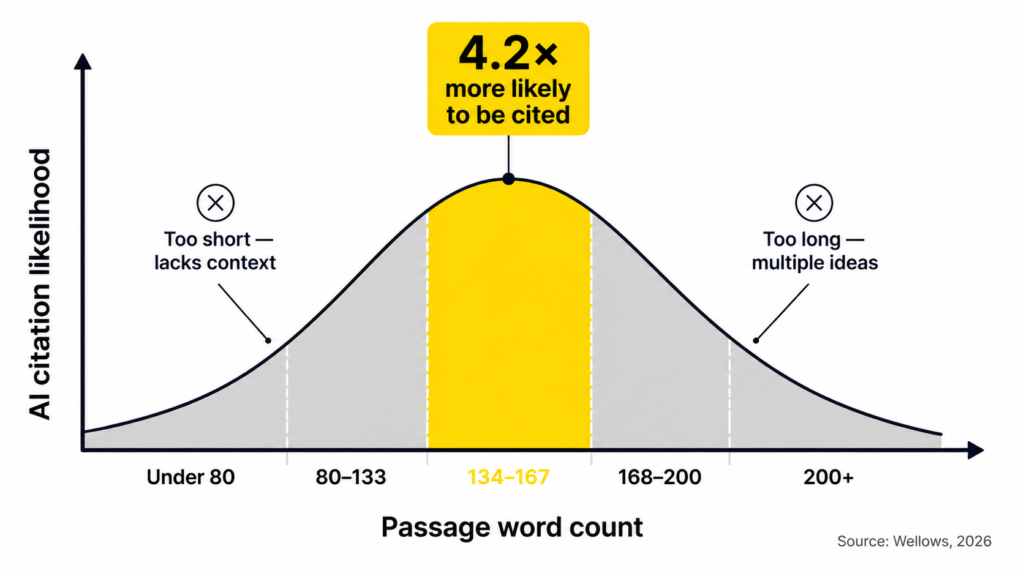
Research from Wellows found that passages in the 134 to 167 word range are 4.2 times more likely to be selected for AI citations than shorter fragments or longer prose blocks. Short fragments lack enough context to be useful on their own; long prose blocks contain multiple ideas and are harder to extract cleanly. The sweet spot is a single well-bounded thought, fully developed, that doesn’t require the surrounding paragraphs to make sense.
WordPress site owners working in the Gutenberg block editor or with page builders like Kadence or Elementor can apply every fix in this post without touching their underlying content. The changes are structural, not editorial.
What does an extractable passage look like?
An extractable passage fully answers one specific question without requiring context from the surrounding text. It doesn’t start with “As mentioned above” or “Building on the previous point.” It opens with the answer, provides the necessary detail, and stops.
Before:
“When we consider the various factors that influence whether AI engines will select a particular piece of content for citation purposes, it becomes apparent that the structural elements of a post play a significant role, particularly when it comes to how passages are formatted and whether they can be understood independently.“
After:
“AI engines select passages that answer one question completely. A passage that requires surrounding context to make sense won’t be extracted. Open with the direct answer, add the necessary detail, and end before you start a new idea.”
The second version opens with the answer, contains the full explanation in under 60 words, and doesn’t reference anything outside itself.
Aim for paragraphs between 80 and 200 words. Shorter than 80 is often a fragment — not enough substance to be a useful citation. Longer than 200 typically contains multiple ideas that should be separate paragraphs.
How do you structure headings for AI extraction?
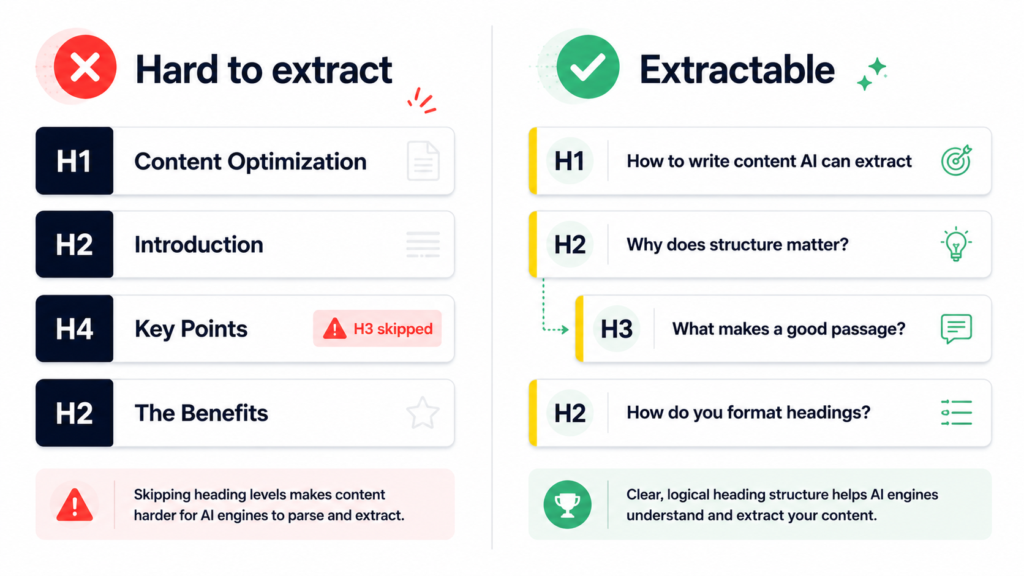
Use question-format headings. Each H2 and H3 should be phrased as the question your content answers in that section — “How do you structure headings for AI extraction?” not “Heading structure.” When a heading is a question, the section that follows has an obvious job: answer it. That makes the structure predictable for both human readers and retrieval systems.
The hierarchy matters too. One H1 per page. H2 for major sections. H3 for sub-topics within a section. Never skip levels — jumping from H2 to H4 creates gaps that confuse crawlers and users alike. Each heading is one extractable topic. If a section covers two distinct questions, split it into two H2s.
Research from AiBoost in March 2026 found that FAQ-structured content gets roughly 40% higher citation weight than equivalent content written as plain prose. Wellows research found separately that pages with 15 or more recognised named entities are 4.8 times more likely to be selected for AI citations — which means question headings and named entities compound each other. Question headings create the same structural boundaries that FAQPage schema creates explicitly, and both signal to Google AI Overviews, Bing Webmaster Tools, and Perplexity’s retrieval layer that extractable content is present.
Does answer-first formatting make a difference?
Yes. Lead every section with a direct, standalone answer — one or two sentences that fully state the conclusion before you explain it. Then expand with evidence, examples, and context.
This is the opposite of how most long-form content is written. Traditional editorial structure builds to the conclusion. AI extraction needs the conclusion first, because retrieval systems scan for the answer to a specific query. They don’t read the whole section to find it.
Before:
“When it comes to optimising content for AI search, there are several considerations that content creators should be aware of. One of the most important involves how the opening of each section is structured…”
After:
“Lead every section with the direct answer. The first sentence should state the conclusion. Everything that follows is supporting evidence.”
The same principle applies at the post level. Open the article with a summary of what it covers. Don’t make the reader scan to find out whether the post is relevant — state it in the first paragraph. AI systems and human readers share this preference: nobody reads a 2,000-word post hoping the point eventually turns up.
Do lists and tables help AI extract your content?
Both. Lists and tables create explicit boundaries that make the relationships between items unambiguous. A retrieval system can pull a bulleted list as a single unit far more reliably than it can identify the same information scattered across a paragraph.
Wellows research found that pages with multi-modal content — text combined with lists, tables, and images — see 156% higher AI selection rates than text-only pages.
|
Use List For |
Use Tables for |
|---|---|
|
Steps in a process |
Comparisons between options |
|
Features or criteria |
Before/after states |
|
Quick-reference takeaways |
Signal-to-outcome mappings |
|
Pros and cons |
Data with multiple attributes |
One caveat: native HTML lists and tables work better than visual replacements built in page builders. Retrieval systems parse actual <ul>, <ol>, and <table> elements cleanly. Custom-styled divs that look like tables don’t carry the same structural signal.
Does a FAQ section help with AI citations?
A FAQ section is one of the highest-impact structural additions to a blog post. Each question-and-answer pair is a pre-built extractable passage: the question defines the scope, the answer provides the complete response. Retrieval systems pull from FAQ sections at a disproportionate rate because the structure does their work for them. When GPTBot, ClaudeBot, or PerplexityBot crawls your page, a FAQ block is the clearest signal that citable, self-contained content is present.
Authoritas research found that 71% of pages ChatGPT cites include structured data markup, and FAQPage schema is the type most directly tied to citation selection. The FAQPage schema signal carries 8 points in the Cite Score — the largest single signal in the Structure category. Tools like Rank Math SEO, Yoast SEO, and the CiteWP Schema Suggestions panel can generate and inject FAQPage JSON-LD directly from your post content without writing a line of code. You can verify it’s working using the Google Rich Results Test, which parses your page and shows every structured data type it detects.
Three to six questions per post is the right range. Keep each answer self-contained (80 to 200 words), and make sure each question is something a real user would actually search for.
What content patterns prevent AI extraction?
Context-dependent openings. Paragraphs that start with “Additionally,” “Furthermore,” “As we covered above,” or “Building on this” signal dependence on surrounding text. A retrieval system pulling that paragraph in isolation gets a fragment, not an answer. Start every paragraph as if it’s the first one a reader will see.
Buried answers. Opening a section with background, history, or qualification before getting to the point. If the answer to the section’s question doesn’t appear in the first two sentences, most retrieval systems won’t find it.
Promotional language. ChatGPT and Perplexity treat promotional content as a signal to deprioritise for citation. uperlatives, vague claims, of superiority, and marketing boilerplate are all flags — the kind of language that reads as advertising rather than information. Research from Averi shows a 26% reduction in citation rate correlated with promotional tone. Write like a reference source, not a product page.
Over-long sections. A 900-word section covering three subtopics looks like one block to a retrieval system. Split it into three H2 sections, each with its own direct opening answer.
How do you check your existing content for extractability?
Go through each H2 section and ask: does the first paragraph answer the question posed by the heading, without requiring context from the rest of the post? If no, move the conclusion to the first sentence. That one change improves extractability more than anything else on this list.
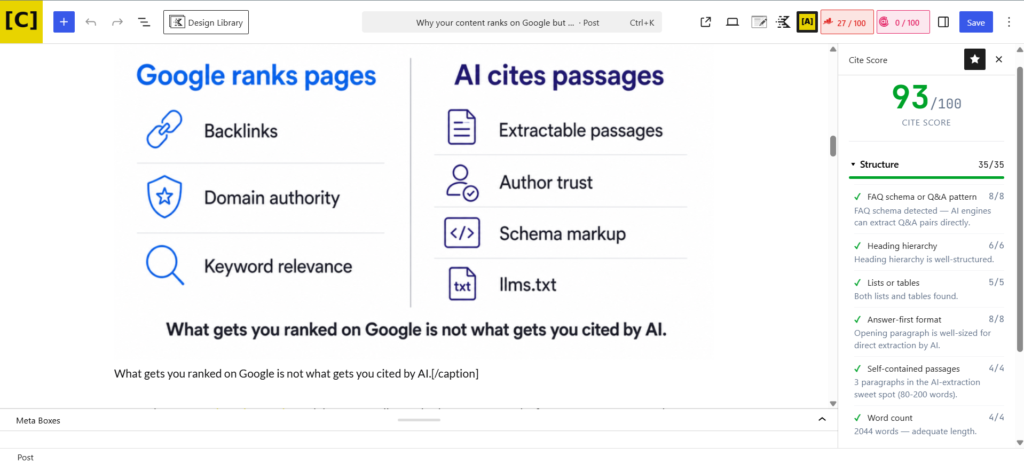
For a full audit across every post on your site, the Cite Score measures extractability directly. It scores passage structure, heading hierarchy, answer-first format, and FAQ pattern as individual signals, and flags exactly which ones are failing and by how much. It runs from the Gutenberg sidebar while you’re editing — no separate tool, no copy-pasting into an external analyser. The CiteWP AI Search Optimizer is free on WordPress.org and covers every post and page on your site automatically on save.
Check your content’s extractability score free →
The short version
AI engines extract passages, not pages. The structural decisions that determine whether a passage gets extracted:
- Open every section with the direct answer (first sentence = conclusion)
- Use question-format H2 and H3 headings
- Keep paragraphs between 80 and 200 words
- Use HTML lists and tables, not prose equivalents
- Add a FAQ section to every substantive post
- Avoid context-dependent openings (“additionally,” “as mentioned above”)
- Write like a reference source, not a product page
The information you already have may be exactly what AI engines need. They just can’t get to it yet.
Frequently asked questions
Get your content cited by AI.
Install CiteWP AI Search Optimizer free on WordPress.org. No account, no credit card.