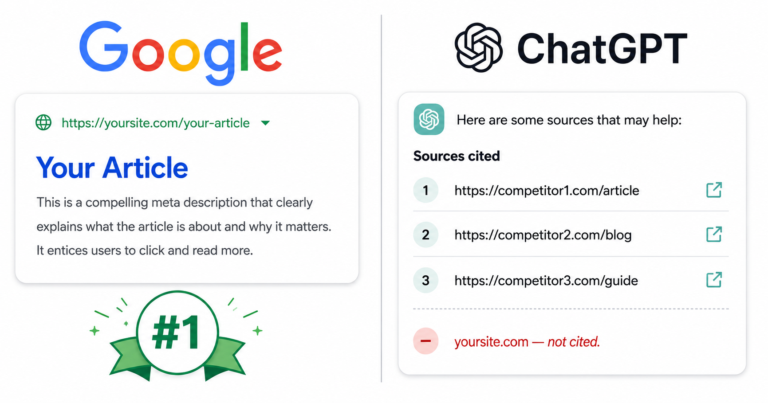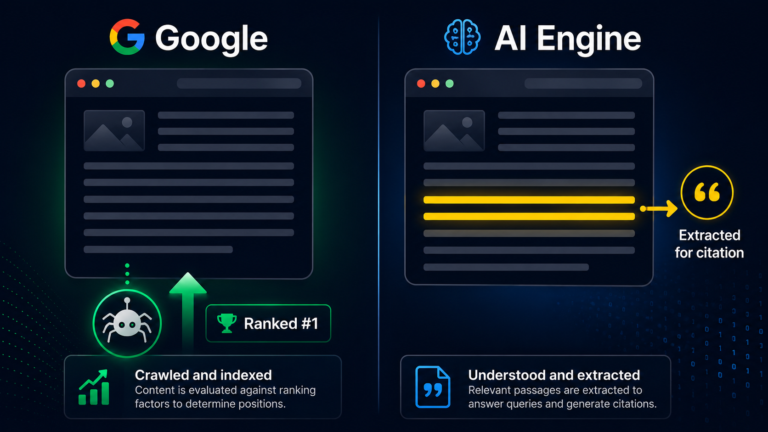
Why AI engines won’t cite content published by “Admin”
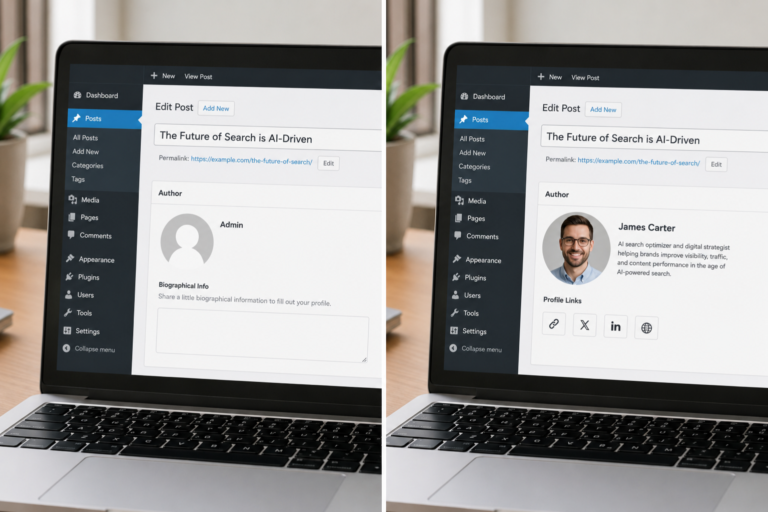
When an AI search engine evaluates a page, one of the first things it checks is whether a real person is accountable for the content. A page published by “Admin” with no author bio, no credentials, and no external attribution is treated as low-trust — regardless of how well the content is written. A 2026 review of AI citation behavior found that 96% of AI Overview citations come from sources with strong E-E-A-T signals. Anonymous content doesn’t make that cut.
For content managers at mortgage companies, law firms, and service businesses, this matters more than for most. These are the industries where AI systems apply the strictest scrutiny to source credibility before citing anything.
What E-E-A-T is and why AI citation changed the stakes
E-A-T has been central to Google’s content quality framework since 2018. In December 2022, Google added the “E” for Experience, creating E-E-A-T: Experience, Expertise, Authoritativeness, Trustworthiness. The update was partly a response to the rise of AI-generated content with no human accountability behind it. The core idea is that content from someone who demonstrably knows what they’re talking about, and can be verified as such, should be treated as more credible than content from an unknown source.
For Google rankings, E-E-A-T isn’t a direct algorithmic signal — it’s a quality framework that human raters apply when evaluating content quality. But AI search engines like ChatGPT, Perplexity, and Claude use the same underlying trust logic when deciding what to cite in a generated answer: is there a named author? Are their credentials verifiable? Do external sources confirm they’re who they claim to be? A page that passes those checks gets cited. A page that fails them gets skipped, regardless of how technically well-formed the content is. Google’s guidance on E-E-A-T covers the framework in detail — it’s written for Google ranking but the trust principles apply equally to AI citation.
This is the part most WordPress site owners miss — and it’s one of the main reasons why Google rankings don’t predict AI citations: authorship was a “nice to have” in traditional SEO. For AI citation readiness, it’s a hard signal worth 6 of the 25 Authority points — 76% of what’s available — before the AI even reads a word.
What AI systems actually check

The `author_byline` signal in CiteWP’s scoring rubric — part of the full Cite Score methodology — grades authorship in three tiers:
|
Authorship state |
Cite score credit |
|---|---|
|
Named author + bio + external profile links |
6 / 6 pts (full credit) |
|
Named author + bio only, no external links |
4 / 6 pts |
|
No named author or no bio |
1 / 6 pts |
A bio with external links earns 50% more author signal credit than a bio alone — 6 points versus 4. The difference comes down to verifiability. A bio that says “Jane Smith is a licensed mortgage broker with 12 years of experience” is a claim. A bio that links to Jane’s LinkedIn profile, her NMLS license entry on NMLS Consumer Access, and her employer’s team page makes the claim checkable. AI systems weight verifiable authorship more heavily because they can follow the chain of evidence — the same reason they credit external citations in body copy more than unsourced assertions.
What counts as a qualifying external profile link:
- Professional licensing page (NMLS Consumer Access, state bar directory, medical board)
- University faculty page
- Professional association member directory
- Industry publication contributor profile
A link back to your own company’s About page doesn’t count — that’s self-attestation, not external verification.
What an author bio actually needs
Most WordPress author bios fail in the same three ways: written in first person with no credential signal (“I love helping clients find their dream home”), no verifiable qualifier, and no external links. That combination earns 1 out of 6 possible author authority points — about 17% of the available author signal.
A bio that earns full credit does four things. First: full name, specific title, and organization. “Jane Smith, Licensed Mortgage Broker, Spokane Loan Team” signals something. “Jane Smith” signals nothing. Second: a credential — any licensure, certification, or verifiable expertise marker relevant to the content. For mortgage: NMLS number. For legal: state bar number. For healthcare: board certification. For agencies and consultants without formal licensing: a specific domain expertise stated precisely, like “10 years managing content for B2B SaaS companies,” or a contributor byline at a recognizable publication. Third: at least one external link — LinkedIn is the baseline, and for regulated industries the licensing page is stronger because it’s government-maintained. Fourth: topical relevance. A loan officer writing about FHA limits needs a bio that signals mortgage expertise. A generic personal statement about being “passionate about helping people” does nothing for AI trust signals and nothing for the reader either. The same principle applies to the body copy itself — see how AI systems extract information from content.
Setting this up in WordPress
WordPress has a built-in biographical info field under Users → Your Profile → Biographical Info. That text renders as the author bio on most themes. The profile page also has fields for website URL, but it only supports one external link natively. To add multiple external profile links — which is what earns full `author_byline` credit — you need either a plugin or theme-level support.
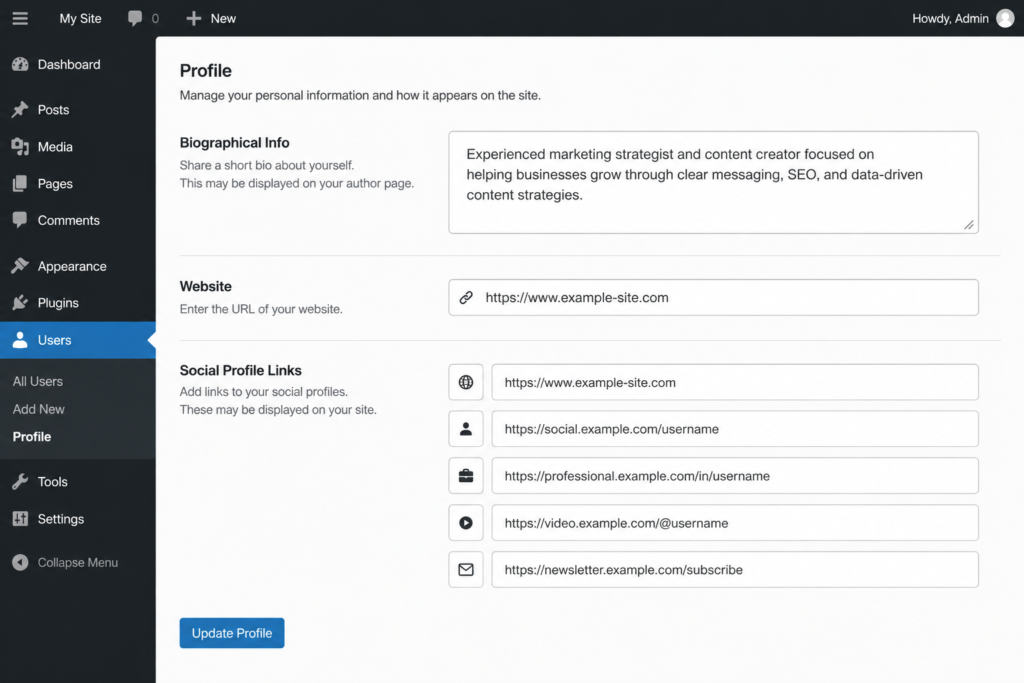
Yoast SEO and Rank Math both have author schema settings that go beyond the WordPress default. In Yoast, go to Search Appearance → General → Knowledge Graph and configure the person or organization settings. In Rank Math, go to Titles & Meta → Global Meta and set the Person schema with the author’s name, same-as URLs, and profile links. Both generate Schema.org Person markup that formally declares the author entity and its external verification URLs — this is what CiteWP credits in the `schema` signal under Authority, and it’s what AI systems read when evaluating whether a source has declared authorship properly.
If your theme doesn’t render the author bio box on posts by default, the Simple Author Box plugin adds a standardized block with social profile links. Setup takes about 10 minutes. Ideal for sites with multiple contributors, it handles per-author configuration so each post inherits the right bio automatically.
For content managers working with a team where posts go up under a single login: the fix is to create individual WordPress user accounts for each contributor, assign posts to the correct author, and configure each user profile with a bio and external links. It’s more setup upfront but each post then carries the right authorship signal.
Regulated industries: authorship isn’t optional
For content managers at mortgage companies, law firms, healthcare clinics, and financial advisory practices, named authorship sits at the intersection of AI citation strategy and basic credibility. AI search engines handling queries in regulated categories — financial advice, medical guidance, legal information — apply stricter scrutiny before citing a source. A page about FHA loan eligibility from a named, NMLS-licensed loan officer is evaluated differently than the same page from “Admin.” The former has a verifiable accountability trail. The latter has none.
YMYL content (Your Money Your Life) is the term Google uses for pages where the stakes of getting bad information are high. AI systems apply the same elevated-scrutiny logic. If the content covers money, health, law, or safety, and there’s no verifiable author attribution, the content is less likely to be cited regardless of how accurate it is. The AI has no way to confirm that the source is credentialed to make the claims it’s making, so it defaults to sources that have demonstrated that chain.
Every post covering a regulated topic needs a named author with the relevant credential visible in the bio. For mortgage, the NMLS Consumer Access database is an externally verifiable, government-maintained public record covering more than 400,000 licensed professionals across all 50 states — linking to a loan officer’s NMLS entry is one of the strongest authorship signals available in that industry. For attorneys, the state bar lookup serves the same function. For healthcare, the appropriate state licensing board. These aren’t optional polish — they’re the difference between content an AI will cite and content it won’t touch.
Frequently asked questions
Get your content cited by AI.
Install CiteWP AI Search Optimizer free on WordPress.org. No account, no credit card.