Why your content ranks on Google but never gets cited by ChatGPT
Content ranks on Google because of backlinks and domain authority. It gets cited by OpenAI’s ChatGPT, Perplexity, Gemini and Claude because of extractable structure, named authorship, and schema markup. Most WordPress sites optimize for the first. Almost none optimize for the second.
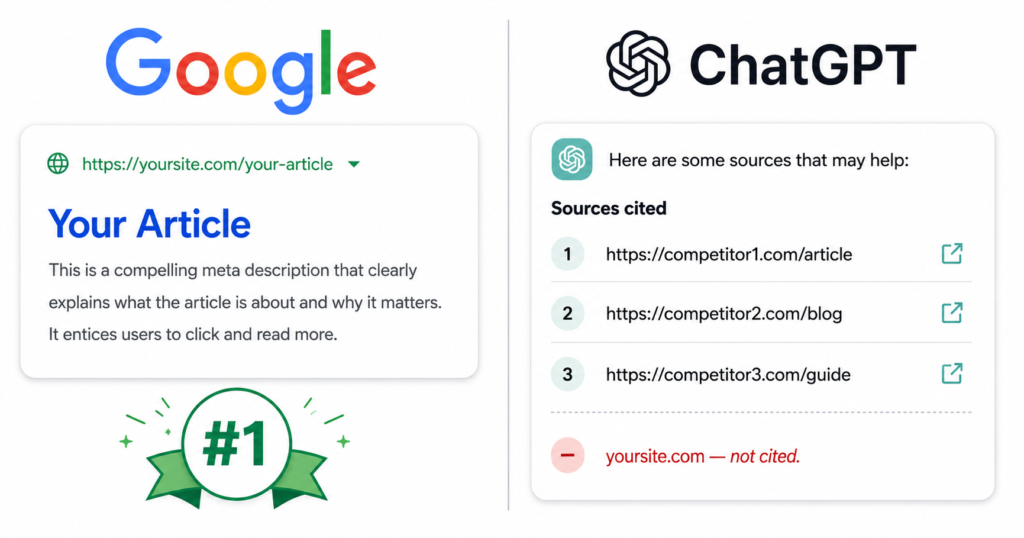
Your content ranks on the first page. Google loves it. You’ve done the work. But ask ChatGPT or Grok about your topic and it cites three of your competitors instead of you. Ask Perplexity or Claude the same question and you’re not there either.
That’s not a content quality problem. It’s a structure problem. Only 11% of domains are cited by both ChatGPT and Google AI Overviews for the same query, according to industry research — which means ranking well on Google is no guarantee of AI visibility.
What is an AI citation?
An AI citation is when ChatGPT, Perplexity, or Claude extracts a passage from your content and presents it — with attribution — as part of a generated answer. It’s distinct from a Google ranking: ranking measures whether your page is worth sending someone to, citation measures whether a specific passage can stand alone as an accurate, complete answer. Your page may never receive the click, but your content gets quoted as a source. The two outcomes require different things. A page can rank number one on Google and receive zero AI citations, or sit at position eight and get cited constantly. The deciding factor is not domain authority or backlinks — it’s whether the right 50 to 167 words are structured so an AI retrieval system can extract them cleanly.
The short version
Five structural reasons AI engines ignore well-ranked content — and a fix for each:
- Your content isn’t extractable as standalone passages
- There’s no named author with credentials
- You’re missing structured data (Article + FAQPage schema)
- AI crawlers are blocked or restricted in your robots.txt
- You have no llms.txt file
None of these require rewriting your content. They’re all structural fixes.
Google and AI engines use completely different signals
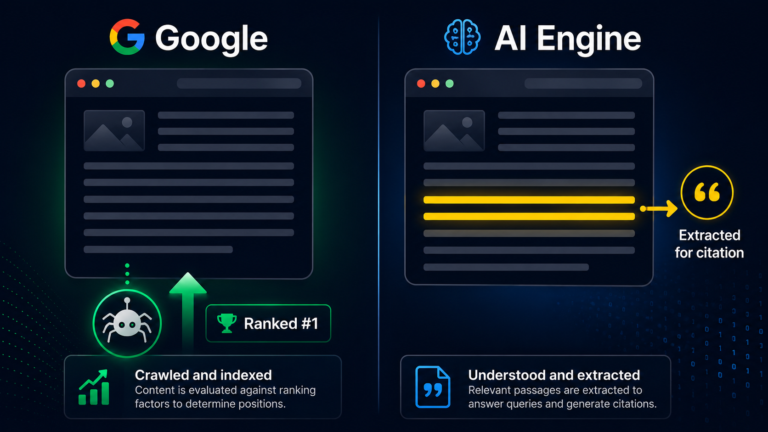
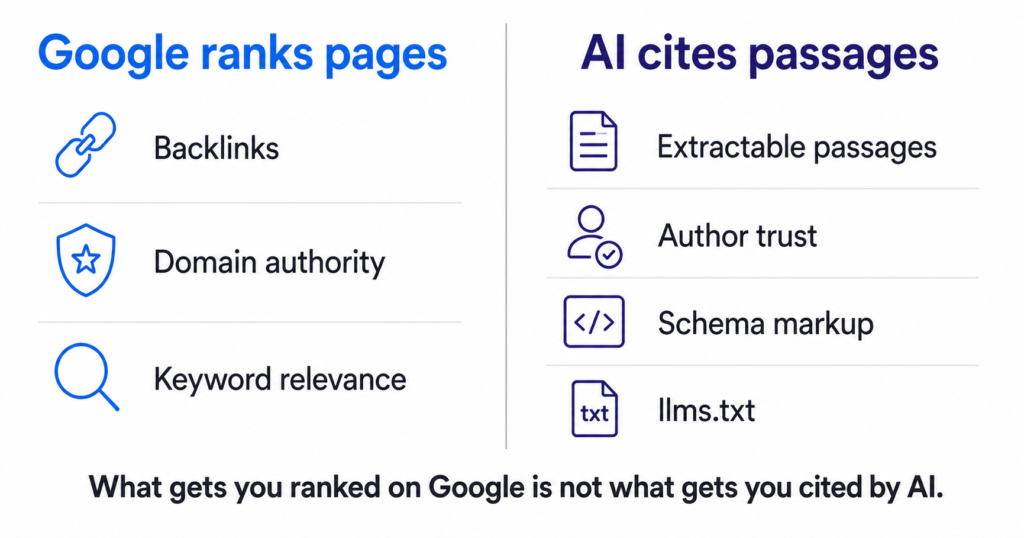
Google ranks pages. AI engines extract passages.
When Google decides to rank your content, it looks at backlinks, domain authority, keyword relevance, and hundreds of other signals built around one question: “Is this page worth sending someone to?” When ChatGPT or Perplexity decides whether to cite you, the question is different: “Can I pull a clean, accurate, self-contained answer from this page?”
You can score well on the first question and fail the second completely. They’re measuring different things — and the audience on the AI side is no longer small. ChatGPT has over 900 million weekly active users according to TechCrunch, and AI-referred sessions grew 527% between January and May 2025 according to SEMRush. Optimising for Google ranking does almost nothing for AI citation visibility.
Research from Search Engine Land found that 44% of all LLM citations come from the first 30% of a page — not the most relevant section, the first section. That’s a structural bias built into how AI retrieval works, and it has nothing to do with your Google rankings.
Reason 1: Why isn’t my content
getting cited by AI?
AI search engines use something called RAG — Retrieval Augmented Generation. Before generating an answer, the AI retrieves relevant passages from pages it has indexed, then uses those passages to construct a response. The key word is passages. Not pages. Not full articles. Chunks of 50-200 words that can stand alone as a complete thought. If your key claim is buried in paragraph 8 inside a 600-word section, the retrieval system may never reach it. If your answer to “what is X?” requires reading three paragraphs of setup before it becomes clear, it won’t get extracted. It’s the most common reason well-ranked content gets zero AI citations.
Content with multi-modal elements sees 156% higher AI selection rates. (Source: Wellows)
The fix
Lead every section with a direct 1-2 sentence answer. Then expand. Every H2 section should open with something that stands on its own — a sentence an AI could quote without needing the surrounding context to make sense of it.
Before: “When we talk about content optimization for AI search engines, there are several important considerations that site owners should keep in mind…”
After: “AI engines cite passages, not pages. Every section should open with a direct answer.”
For the full breakdown on passage structure, headings, and answer-first formatting, see how to write content AI can actually extract.
Reason 2: Does named authorship affect AI citations?
AI engines treat unnamed content as lower trust. ChatGPT sources heavily from Bing’s index, and Bing’s quality evaluation includes author expertise as an E-E-A-T signal — a page with no visible author is, by definition, an unknown expert making unverifiable claims.
AI engines weight E-E-A-T signals heavily. Experience, expertise, authoritativeness, trustworthiness. These aren’t just Google concepts — every major AI platform uses some version of them when deciding whether a source is worth citing. Content published without a named author, without a bio, without any signal of who wrote it and why they’re qualified — that content scores lower on trust signals. Not because AI is reading your bio and judging it. Because the absence of author information is itself a signal.
An Ahrefs study of 75,000 brands found that brand mentions correlate three times more strongly with AI citation visibility than backlinks — and the strongest individual signal is YouTube mentions, with a 0.737 correlation score.
The fix
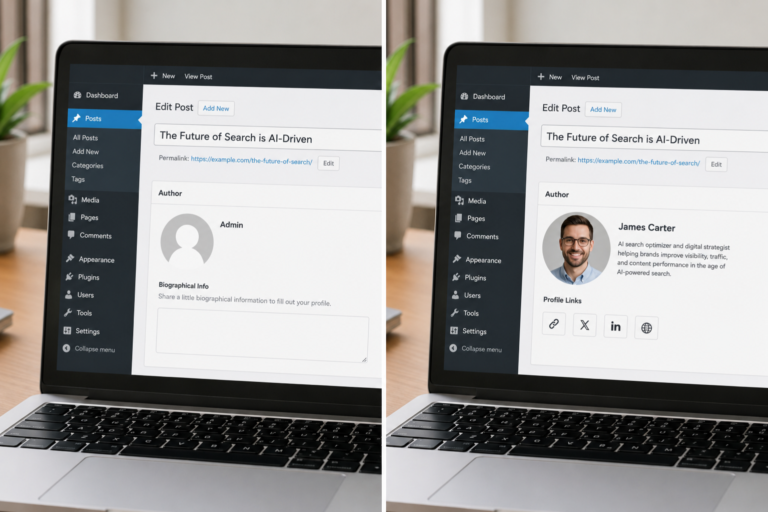
Add a named author to every post. Build out a proper author page with a real bio, relevant credentials, and links to social profiles. Make the author visible at the top of the post, not buried in a footer.
If your WordPress theme hides or removes the author display, fix that before you publish another post. The byline is not decoration. It’s a trust signal that affects whether AI engines cite your content.
Reason 3: Does schema markup help ChatGPT cite your content?
Authoritas found that 71% of pages ChatGPT cites include some form of structured data markup. A separate analysis showed that pages with FAQPage schema get cited roughly 40% more often than pages without it. ChatGPT pulls heavily from Bing’s index, and Bing Webmaster Tools still weights structured data as a ranking signal. Schema helps Bing understand what a page is about, which influences how ChatGPT selects sources.
Two schema types matter most for blog content:
| Schema type | What it tells AI | Where to add it |
|---|---|---|
| Article | Author, publish date, last updated | Rank Math,Yoast SEO, AIOSEO → Schema tab |
| FAQPage | Structured Q&A AI can extract directly | Kadence Accordion or Rank Math FAQ block |
The fix
If you’re using Rank Math or Yoast SEO, both can generate Article schema automatically. For FAQPage schema, add a FAQ section at the end of every post and mark it up correctly — or use Kadence Accordion blocks, which handle FAQPage schema in Kadence Pro. Then add FAQPage schema to your Q&A blocks.
If you’re not sure whether your pages have schema, paste any post URL into Google Rich Results Test and check what structured data it detects.
Reason 4: Could your robots.txt be blocking AI citations?
If an AI search engine can’t crawl your content, it can’t cite it. Simple as that.
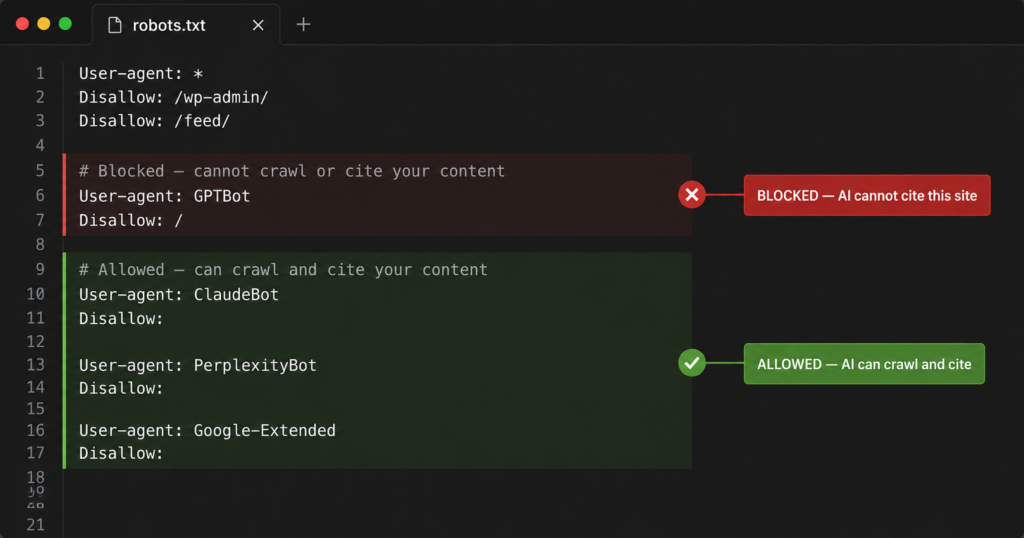
Each major AI platform has its own crawler. These are separate from Googlebot and other traditional search crawlers. A robots.txt rule that blocks them — even unintentionally — means those platforms have no access to your content at all. Some WordPress security plugins, hosting configurations, or misconfigured robots.txt files block these crawlers without the site owner ever knowing. Most people haven’t checked.
The fix
Open your robots.txt file in Google Search Central (yoursite.com/robots.txt) and look for Disallow rules targeting any of these bots: GPTBot, ChatGPT-User, ClaudeBot, Anthropic AI, PerplexityBot, Google-Extended. If you find any of them blocked, you have a decision to make. Blocking prevents AI training on your content. But it also prevents citation.
Most content publishers are better served by allowing inference crawlers while optionally blocking training-focused bots — but that distinction requires knowing which is which.
Reason 5: Why does your site need an llms.txt file?
robots.txt tells crawlers what they can’t access. llms.txt tells AI engines what’s most worth their attention.
Think of it as a sitemap built specifically for AI. It tells them which pages matter, what the site covers, and what to prioritize when a question touches your topic.
Most WordPress sites don’t have one. So AI engines guess at what matters — and often get it wrong.
The fix
Generate a llms.txt file and place it in your WordPress root directory, accessible at yoursite.com/llms.txt. It should include links to your key pages, a short description of what your site covers, and optionally a full-text version (llms-full.txt) for AI systems that want deeper context.
How to check all of this at once
Running through five different checklists manually across every post on your site isn’t realistic.
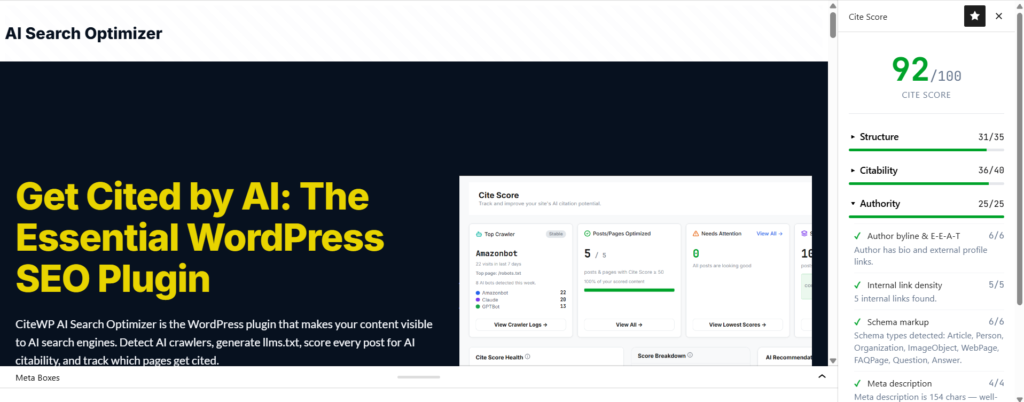
The Cite Score measures all five of these signals — plus twelve more — across every post on your WordPress site. It’s a 100-point score that lives in the Gutenberg sidebar so you can see where each post stands while you’re editing it, not after you’ve published.
The rubric is public at citewp.com/cite-score. Every signal is listed with the research behind why it’s weighted the way it is. No black box.
Check your Cite Score free on WordPress.org →
The recap
Ranking well on Google proves your content is valuable. Not being cited by AI means your content isn’t structured in a way AI engines can use.
Those are two different problems with two different fixes. The fixes are structural, not creative. You’re reformatting, not rewriting.
- Lead every section with a direct, standalone answer
- Add a named author with credentials to every post
- Add Article and FAQPage schema to your pages
- Verify AI crawlers aren’t blocked in your robots.txt
- Generate a llms.txt file for your site
If you want to see exactly how your current posts score on each of these signals, that’s what the Cite Score is for. Install CiteWP free on WordPress.org and open any post in the editor.