

Cite Score Guide
The Cite Score is a 100-point measure of how ready your WordPress content is to be cited by AI search engines — ChatGPT, Claude, Perplexity, and others. This guide documents every signal, threshold, and weight.
CiteWP publishes the full rubric because scoring shouldn’t be a black box. Everything on this page matches the actual logic running in the plugin. If you want to improve your score, start with the signals flagged in the Cite Score sidebar — that’s where the gaps are.
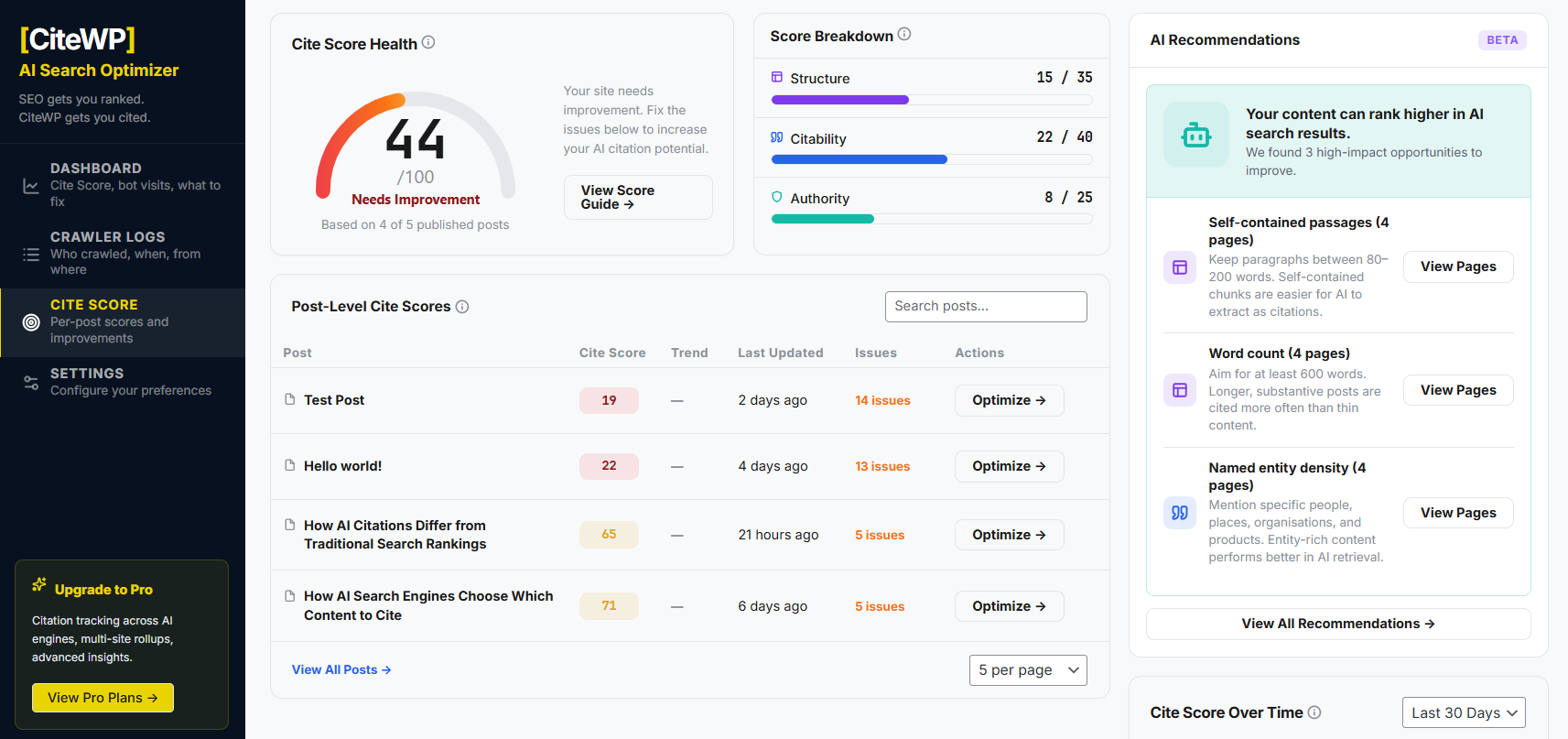
How Cite Score is Calculated
Every post or page gets a Cite Score broken down across three categories totaling 100 points. Within each category, individual signals contribute partial or full credit depending on whether your content meets the thresholds documented below.
The score updates automatically on save. You can also trigger a fresh calculation manually with the Recalculate button in the Cite Score sidebar.
CATEGORY 1
35 PointsStructure
Measures how easily AI engines can parse your page into extractable sections. Headings, FAQ patterns, lists, tables, and self-contained passages all signal that content is ready for extraction and citation. description.
CATEGORY 2
40 PointsCitability
Measures whether your content contains the factual elements AI engines weight as authoritative. Statistics, external citations, named entities, and a non-promotional tone are the signals that move content from readable to quotable.
CATEGORY 3
25 PointsAuthority
Measures the trust signals on your post and your site overall. Author bios, schema markup, internal linking, meta descriptions, and featured images all build the E-E-A-T signals AI engines weight when deciding which source to cite.
Score Bands
The overall Cite Score lands in one of four color-coded bands that signal how citation-ready your content is to AI search engines. The same banding logic applies to individual category scores within Structure, Citability, and Authority.
| Score Range | Band | Meaning |
|---|---|---|
| 80 to 100 | Green | Strong AI citation readiness. Your content has the structural, factual, and authority signals AI engines weight heavily. |
| 60 to 79 | Yellow | Good foundation with room to improve. Most signals are passing or near full credit; a few specific gaps remain. |
| 40 to 59 | Orange | Significant gaps. Content has some scoring signals but is missing structural or authority elements AI engines look for. |
| 0 to 39 | Red | Major work needed. The content is not yet structured for AI extraction or citation. |
A category at 80 percent of its possible points shows green in the Cite Score sidebar, 60 percent shows yellow, 40 percent shows orange, anything below 40 percent shows red. So a Structure score of 28 out of 35 reads as green at the category level, while a Citability score of 22 out of 40 reads as orange.
Structure signals
The Structure category measures how easily AI engines can parse your page into extractable sections. AI assistants do not read pages start to finish like a human visitor. They extract specific passages to use as citations, and the structural cues on your page determine whether extraction succeeds. Structure is worth 35 points across six signals.
STRUCTURE
Can AI extract from this page?
AI assistants don’t read pages top to bottom. They extract specific passages, and if your page’s structure doesn’t make those passages easy to find, they move to a different source. Structure signals measure whether your headings, FAQ patterns, lists, and paragraph layout make content easy to lift. 35 points across six signals.
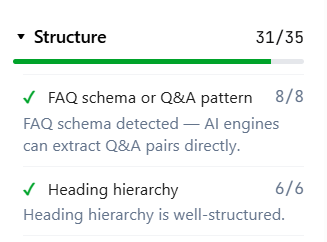
FAQ schema or Q&A pattern (8 points)
CiteWP awards full credit when your page contains FAQPage or Question schema in JSON-LD format. Partial credit is awarded for question-format headings even without schema: three or more question-format headings earns 5 points, one or two earns 2 points. A heading is considered question-format when it starts with words like How, What, Why, When, Where, Can, Should, or ends with a question mark.
To improve this signal, mark up your Q&A sections with FAQPage schema. The Schema Suggestions panel in the CiteWP sidebar will insert valid JSON-LD when your content has two or more question and answer pairs. Research from AiBoost in March 2026 found that FAQ-structured content sees roughly 40 percent higher citation weight than plain prose, which is why this signal carries 8 points despite being one of the smaller signals by category share.
Heading hierarchy (6 points)
Full credit requires at least two headings on the page with no level-skips. A level-skip means jumping from H2 directly to H4 without an intermediate H3, or starting the page with H2 instead of H1. Each detected skip subtracts 2 points from the signal score, and a page with no headings or only one heading earns no more than partial credit.
The fix is to walk through your headings in order and ensure each one is at the correct level relative to its parent: one H1 per page, H2 for major sections, H3 for subsections under each H2. If you are using a page builder, some templates default content to non-heading tags or skip levels, and those need correcting manually in the block settings. Heading structure helps AI engines understand the topical hierarchy of your content for citation matching.
Lists or tables (5 points)
Full credit requires both lists and tables somewhere on the page. Lists only earns 3 points, tables only earns 2 points, neither earns zero. AI engines extract list and table content more readily than prose because the structural delimiters make boundaries explicit and the relationships between items are unambiguous.
If your page has bullet lists already, adding a single comparison table moves you from 3 to 5 points. Common useful tables include feature comparisons, pricing tiers, before-and-after states, or option matrices. Native HTML tables work better than page-builder table widgets for this signal because they render as actual table elements that AI engines can parse cleanly.
Self-contained passages (4 points)
CiteWP counts paragraphs in the 80 to 200 word range. Three or more such paragraphs on the page earns full credit. One or two earns 2 points. None earns zero. A self-contained passage is one that fully answers a sub-question without requiring context from surrounding paragraphs.
Research from Wellows in February 2026 found that 134 to 167 word self-contained passages are 4.2 times more likely to be cited than shorter fragments or longer blocks. When writing, aim each paragraph at one specific question a reader might ask and provide the full answer in that paragraph. Avoid starting paragraphs with words like “additionally” or “furthermore” that signal dependence on preceding context.
Answer-first format (8 points)
The opening paragraph of your content is scored for length. A 30 to 80 word opening paragraph earns full credit. An 81 to 167 word opening earns 6 points. Fewer than 30 words earns 3 points. Longer than 167 words earns 2 points.
The reason: AI engines often extract the first paragraph as a direct answer to a query. A paragraph in the 30 to 80 word range is long enough to convey a complete thought and short enough to extract cleanly into an AI-generated response. Longer openings get truncated or skipped entirely, and very short openings lack enough content to cite. Start each post or page with a focused, single-paragraph answer to the main question the page addresses.
Word count (4 points)
Pages need 300 or more words for full credit. Posts need 800 or more words. Reaching 60 percent of the target threshold earns 2 points. Falling below 60 percent earns zero. The thresholds reflect what AI engines treat as substantive enough to cite.
A 200 word page reads as a stub to most crawlers and is unlikely to be cited regardless of how strong other signals are. The fix is straightforward: expand thin content with genuine substance rather than filler. If a page or post is conceptually thin, consolidate it with related pages or expand the analysis with examples, data, and context that reward longer reading.
CITABILITY
Will AI quote this?
AI assistants cite content that reads like a source: specific numbers, named organizations, links to external research, and a tone that isn’t trying to sell anything. Citability signals measure whether your content clears that bar. At 40 points it’s the biggest category by weight — more than Structure and Authority put together.
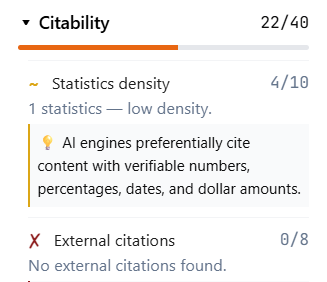
Statistics density (10 points)
CiteWP detects percentages, dollar amounts, years, comma-formatted numbers, and multiplier shorthand like 4x or 156 percent. Eight or more statistics per 1000 words earns full credit. Four to seven per 1000 words earns 7 points. One or more earns 4 points. Zero earns nothing. This is the largest single signal in the Citability category at 10 points, reflecting how heavily AI engines weight verifiable numbers.
Concrete numbers make claims verifiable. Research from Averi in April 2026 found that statistics density correlates with a 41 percent improvement in AI visibility. To improve this signal, replace vague claims with specific ones. Instead of “many users” write “thousands of users.” Instead of “fast” write “under 60 seconds.” Each concrete number is a citability signal that compounds with others on the page.
External citations (8 points)
CiteWP scores outbound links to authoritative external sources. Three or more outbound citation links earns full credit. One or two earns 4 points. Zero earns nothing. The signal looks for actual links to external domains, not mentions of sources without links.
AI engines weight cross-referenced content significantly higher than uncited claims. Research from Wellows found a correlation of 0.89 between cross-referenced facts and citation likelihood, which is one of the strongest signals measured in GEO research. The practical implementation is to link to original research, official documentation, government sources, peer-reviewed studies, and other primary sources when you reference facts. Each meaningful outbound link strengthens both citability and your content’s perceived authority.
Named entity density (7 points)
CiteWP uses regex heuristics to count capitalized multi-word phrases that are likely named entities such as people, organizations, places, or products. Fifteen or more named entities earns full credit. Eight to fourteen earns 4 points. One to seven earns 2 points. The entity counter is heuristic in this version and may produce some false positives. Future versions will integrate full named entity recognition.
Research from Wellows shows that pages with 15 or more recognized entities are 4.8 times more likely to be selected for AI citations. To improve this signal, mention specific organizations, products, places, and people by name where relevant. Generic phrases like “a popular plugin” become “Yoast SEO” or “Rank Math” with the entity-strengthening effect. Named entities give AI engines anchor points for understanding which topics your page actually covers.
Non-promotional tone (8 points)
CiteWP scans for 16 common promotional superlatives. The full list of detected terms is documented in the plugin source code at Includes/Scoring/ContentAnalysis.php.
Research from Averi shows that promotional tone correlates with a 26 percent reduction in citation rate. AI engines treat promotional language as a marketing signal rather than an informational one and weight cited content accordingly. Replace superlatives with specific claims. For example, rather than asserting that your plugin is superior to alternatives in general terms, name the specific feature that differentiates it. The phrase ‘the only WordPress plugin with citation tracking’ makes a verifiable claim. Vague superlative phrasing does not.
Freshness (4 points)
Content updated within the last 90 days earns full credit. Content updated 91 to 365 days ago earns 2 points. Older than 365 days earns zero. CiteWP reads the post’s modified date from WordPress, which updates automatically when you save a post with changes.
AI engines preferentially cite recent content because much of the information they synthesize is time-sensitive. The fix is simple: review your evergreen content periodically and update it with current information, then save the post to refresh its modified date. A genuine update of a few paragraphs is appropriate; resaving without changes is not, and search engines have become better at detecting that pattern over time.
Defined audience or use case (3 points)
CiteWP scans for audience markers including phrases that explicitly call out who the content is written for, who should use it, when to use it, and use case framing. The full list of detected markers is documented in the plugin source code at includes/Scoring/ContentAnalysis.php. Two or more markers earns full credit. One marker earns 2 points. None earns zero. This is the smallest signal in the Citability category at 3 points but it influences how AI engines match your content to user queries.
AI engines cite content that explicitly states who it is for and when it applies, because those signals help the AI match the content to a user query. Generic content without audience signals is harder for an AI to match to a specific question. To improve this signal, add explicit audience phrases naturally throughout the content, particularly in introductions and section openers. Phrases like “for WordPress site owners who” or “use this when” anchor your content to specific user contexts.
Should I trust this?
AI engines weight authority heavily when deciding which source to cite for a given query. Authority signals measure the trust markers on your post and your site overall: who wrote it, how it connects to other content, what structured data it carries, and whether it presents itself as a complete piece of work. Research from Wellows shows that 96 percent of AI Overview citations come from sources with strong E-E-A-T characteristics — Experience, Expertise, Authoritativeness, and Trustworthiness. The Authority category is worth 25 points across five signals.
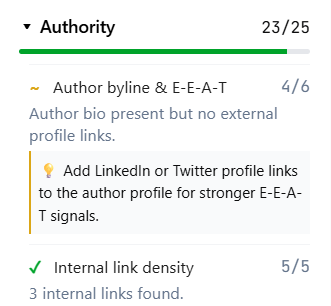
Author byline and E-E-A-T (6 points)
Full credit requires an author bio plus at least one external profile link, such as a Twitter or LinkedIn URL or a personal website. Bio only earns 4 points. Neither earns 1 point. No author info attached to the post earns zero. This is the largest signal in the Authority category at 6 points, reflecting how heavily AI engines weight author credibility.
The fix happens in your WordPress user profile rather than per-post. Navigate to Users in your WordPress admin, edit your profile, fill in the Biographical Info field with a meaningful bio that establishes expertise on the topics you write about, and add your external profile URLs. Setting these up once benefits every page on your site authored by you. Research from Wellows shows that 96 percent of AI Overview citations come from sources with strong E-E-A-T characteristics, which is why a single bio update can move scores across an entire site.
Internal link density (5 points)
Three or more internal links to other pages on your site earns full credit. One or two internal links earns 3 points. Zero earns nothing. The signal counts only internal links, not outbound external links, which are scored separately under the Citability category.
Internal links signal topical authority and help AI engines understand the relationships between pages on your site. The fix is to find two or three places in your content where you naturally reference another page on your site and add a link. Avoid forced linking; natural references work better than crammed link blocks. Pages that link to and from related content read as part of a coherent body of work rather than as isolated pieces.
Schema markup (6 points)
CiteWP awards full credit when JSON-LD schema is present in your post content. Partial credit of 3 points is awarded when an SEO plugin such as Yoast, Rank Math, AIOSEO, or SEOPress is active on your site, since these plugins output schema at the page render layer where CiteWP cannot currently inspect them directly.
To earn full credit, use the Schema Suggestions panel in the CiteWP sidebar to insert Article or FAQPage JSON-LD directly into your post content. Combining inline schema with your SEO plugin’s render-layer schema is valid and common, though future CiteWP versions will detect render-layer schema directly to close the partial-credit gap. Schema markup gives AI engines explicit, machine-readable definitions of what your page is about, which is foundational for accurate citation matching.
Meta description (4 points)
A meta description in the 120 to 160 character range earns full credit. 70 to 119 characters earns 2 points. Shorter or longer earns zero. CiteWP reads meta descriptions from Yoast, Rank Math, AIOSEO, or the post excerpt in that order, using whichever source is available first.
The fix is to set a meta description in your SEO plugin that falls within the optimal range. Search engines and AI engines both use meta descriptions as a content summary, and well-sized descriptions are more likely to appear verbatim in search results and AI citations. Treat the meta description as a one-sentence pitch for the page that stands alone without needing context from the page itself.
Featured image with alt text (4 points)
Full credit requires a featured image set on the post plus alt text that contains at least four words. Image with brief alt text earns 2 points. Image without alt text earns 1 point. No featured image earns zero. The four-word threshold filters out one-word filenames and generic placeholders that do not actually describe the image.
Multi-modal content sees a 156 percent higher selection rate in AI citations according to research from Wellows in February 2026. To improve this signal, set a featured image relevant to your content and write descriptive alt text that accurately describes the image in at least four words. Avoid filename-style alt text like “screenshot1.png”; write natural descriptions that would make sense if read aloud by a screen reader to someone who cannot see the image.
How CiteWP differs from traditional SEO
Yoast and Rank Math score content for search engine ranking. CiteWP scores for AI citation. They overlap — schema, heading structure, and authority signals matter for both — but they split on what else counts.
CiteWP AI Search Optimizer weights factual density, external citations, and self-contained passage structure more than any traditional SEO tool. It also penalizes promotional tone, which most SEO scoring ignores. AI engines select content to quote, not content to rank — different criteria.
CiteWP works alongside your existing SEO plugin. Yoast and Rank Math handle ranking. CiteWP handles citation readiness. SEO gets you ranked; CiteWP gets you cited.
Improvement workflow
- Work category by category. Start with the lowest-scoring category. Within each category, focus on signals worth more points first. A 6-point signal at zero credit is worth fixing before a 3-point signal at partial credit.
- Use the sidebar recommendations. Open a post in the WordPress editor and view the Cite Score sidebar. Each signal shows its current score, a brief explanation of what was detected, and a specific recommendation when partial or no credit was awarded. Address the recommendations in order.
- Save before recalculating. The Cite Score reads the saved version of your post content. Save the post after each meaningful change to trigger a fresh score calculation. The Recalculate button manually re-runs scoring on the current saved version.
- Stack quick wins first. Structural fixes like adding a comparison table, splitting a long paragraph into self-contained passages, or correcting heading hierarchy take minutes and move scores by several points each. Citability improvements like adding outbound citations and replacing marketing language with specific claims are similarly fast.
- Make site-wide changes once. Authority signals like setting up your author bio and adding a featured image benefit every page on your site at once. A single bio update can move scores across an entire site.
Research sources
The Cite Score rubric is calibrated against published 2026 research on Generative Engine Optimization. The primary sources informing CiteWP’s weights and thresholds are listed below. CiteWP updates the rubric as new research emerges, and if the underlying weights change, this page is updated and the changelog notes the methodology shift.
- AiBoost (March 2026) — ChatGPT ranking factors analysis, reporting findings from Authoritas including the approximately 40 percent higher citation weight for FAQ-structured content.
- Wellows (February 2026) — Google AI Overviews ranking factors study reporting semantic completeness r=0.87 correlation, multi-modal content +156 percent selection rate, named entity density 4.8x boost at 15+ entities, and 96 percent of AI Overview citations from sources with strong E-E-A-T characteristics.
- Averi (April 2026) — GEO citation metrics framework documenting statistics density correlating with 41 percent AI visibility improvement and promotional tone correlating with -26.19 percent citation rate.
For the full canonical scoring rubric including signal IDs, exact pass/partial criteria, and implementation details, see the source-of-truth rubric document linked in the CiteWP plugin source code.
Get your content cited by AI.
Install CiteWP AI Search Optimizer free on WordPress.org. No account, no credit card.